The ruler is not held outside the universe. It was made by the same history it measures. Pressure waves traveled through the young plasma before stars existed; their reach left a slight preference in the distances between galaxies. Cosmologists now use that fossil scale to measure the later expansion. Doing so requires an account of how the ruler was made.
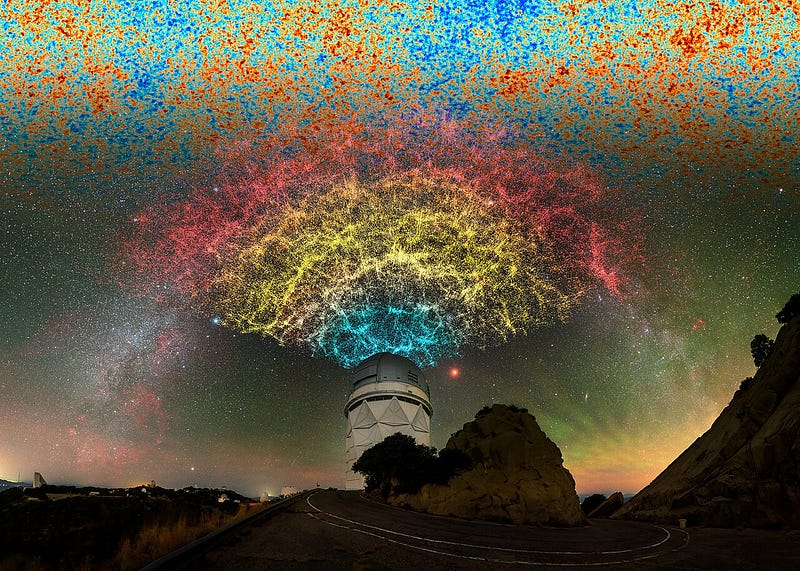
The ruler before galaxies
Before neutral atoms formed, ordinary matter existed as an ionized plasma coupled tightly to radiation. Gravity drew overdense regions inward while photon pressure resisted compression. The competition launched acoustic waves through the photon-baryon fluid. Recombination allowed most photons to travel freely as the radiation now observed in the cosmic microwave background. Residual momentum exchange continued for a short interval, however, so the acoustic scale relevant to late-time matter is conventionally evaluated at the baryon drag epoch rather than exactly at last scattering.1
The sound horizon is the greatest comoving distance an acoustic disturbance could travel before that release:
Its value is inferred from early-universe physics. Once calibrated, its apparent dimensions at later redshifts constrain two different combinations. Across the line of sight, the ruler measures the transverse comoving distance DM(z)/rd. Along the line of sight, it measures the Hubble distance DH(z)/rd, where DH = c/H(z). The familiar angular-diameter distance is related by DM = (1 + z)DA.
The imprint is not a rigid shell visible around each galaxy. It appears statistically as a small excess probability of finding pairs of galaxies at a preferred comoving separation. In configuration space, that excess forms a peak in the two-point correlation function. In Fourier space, the same physics appears as oscillations in the matter power spectrum. Its first clear detection in the low-redshift galaxy correlation function supplied a standard ruler with the same early-universe origin as the acoustic structure in the microwave background.2
From a ruler to an expansion history
In the standard ΛCDM model, the present universe is composed primarily of cold dark matter and a dark-energy component represented by the cosmological constant Λ, with ordinary baryonic matter contributing only a few percent of the total energy density. The Friedmann equation relates those components to the evolution of the scale factor. BAO measurements do not independently reveal every term. Combined with the cosmic microwave background, supernovae, and other probes, they restrict which expansion histories remain possible.
The Dark Energy Spectroscopic Instrument was built to make this reconstruction unusually precise. Mounted on the Mayall telescope at Kitt Peak, DESI uses 5,000 robotically positioned fibers to collect spectra from galaxies and quasars. Redshifts turn their angular positions into a three-dimensional map extending across a large fraction of the observable sky.3
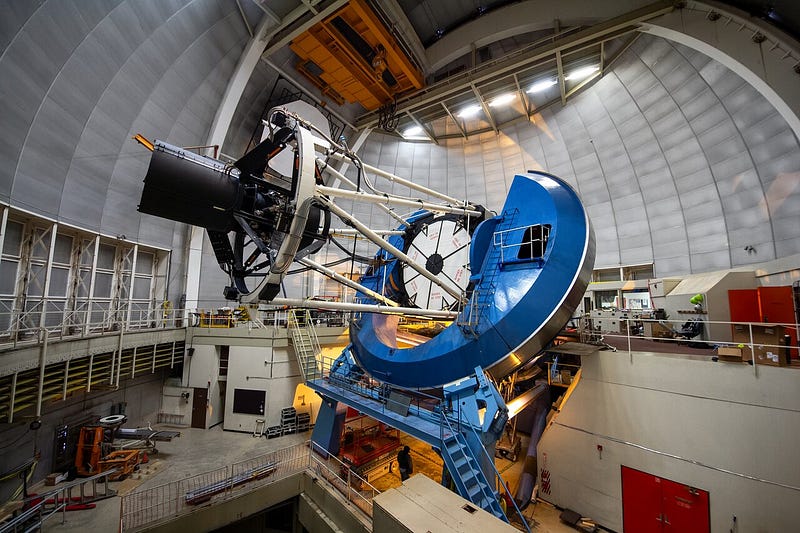
DESI’s year-one BAO measurements, released in 2024, began to test ΛCDM across several redshift ranges.4 The tension was sometimes described too loosely. DESI had not shown that the ruler itself was unstable or that galaxies were simply “too clustered.” Rather, combinations of BAO, microwave-background, and supernova datasets gave a better fit to some models in which the dark-energy equation of state evolves with time than to a strict cosmological constant. The statistical preference depended on which supernova compilation was used.
DESI’s subsequent three-year analysis increased the cosmological sample to more than fourteen million galaxies and quasars. Data Release 2 found that a spatially flat ΛCDM model still describes DESI BAO and the cosmic microwave background well, while the preferred matter-density values differ at roughly 2.3 standard deviations. When the dark-energy equation of state is allowed to vary with time, DESI and CMB data prefer that extension to ΛCDM at about 3.1 standard deviations; adding supernova distances shifts the preference between 2.8 and 4.2 standard deviations, depending on the compilation.5
Those numbers are not interchangeable with a discovery probability. They describe model comparisons inside a chosen parameterization, and some of their force enters only when partially discordant datasets are combined. BAO alone does not announce a new component. The inference emerges from joint likelihoods, assumptions about the early-time sound horizon, a two-parameter form for w(z), and datasets carrying their own covariances and possible systematics. The word hint remains essential.
This dependence is not an embarrassment. Precision cosmology advances by making assumptions explicit enough to be injured by data. A deviation can arise from dark-energy dynamics, an imperfect model of early-universe calibration, residual systematics, or a parameterization flexible enough to absorb disagreement among datasets. Additional DESI observations, independent supernova analyses, weak lensing, microwave-background measurements, and cross-survey consistency tests will decide how much structure the anomaly can bear.
In April 2026, DESI completed its planned five-year observing program after recording spectra from more than forty-seven million galaxies and quasars. The collaboration has extended observations through 2028; the full five-year dark-energy analysis is expected in 2027.6 More data will narrow the statistical region, but the sharper gain may come from redundancy: repeated analyses, alternative distance ladders, cross-correlations, and models forced to explain several observables at once.
A change in the inferred expansion history can therefore reach backward into the calibration of the ruler, or forward into the behavior of dark energy. The task is to find a history that survives both tests: one that could have made the acoustic scale we inherit and stretched it into the separations we measure.
References
- P. J. E. Peebles and J. T. Yu, “Primeval Adiabatic Perturbation in an Expanding Universe”, Astrophysical Journal 162, 1970. ↩
- Daniel J. Eisenstein et al., “Detection of the Baryon Acoustic Peak in the Large-Scale Correlation Function of SDSS Luminous Red Galaxies”, Astrophysical Journal 633, 2005. ↩
- DESI Collaboration, “The DESI Experiment Part I: Science, Targeting, and Survey Design”, 2016. ↩
- DESI Collaboration, “DESI 2024 III: Baryon Acoustic Oscillations from Galaxies and Quasars”, 2024. ↩
- DESI Collaboration, “DESI DR2 Results II: Measurements of Baryon Acoustic Oscillations and Cosmological Constraints”, 2025. ↩
- DESI Collaboration, “DESI Reaches Mapping Milestone, Surpassing Expectations”, 15 April 2026. ↩