Maxwell’s equations contained an awkward implication. They described electromagnetic waves traveling at a fixed speed, yet nineteenth-century mechanics expected velocities to add: a pursuer should measure a wave differently from an observer at rest. The difficulty was not merely about light. It concerned the structure by which any two observers could compare space and time.
The Michelson-Morley experiment of 1887 searched for motion through the hypothetical luminiferous aether by comparing light sent along perpendicular paths. It found no aether wind of the expected kind. That null result was historically important, though special relativity did not arise from one experiment alone. By 1905, Einstein recast the problem around two principles: the laws of physics take the same form in every inertial frame, and light in vacuum has the same measured speed for every inertial observer.
The consequence is often phrased as though space and time “warp” to protect light. More precisely, spatial and temporal coordinates depend on the observer’s inertial frame, while a combined quantity, the spacetime interval, does not. Two observers may disagree about the duration between events or the distance separating them and still agree on the interval that joins those measurements.
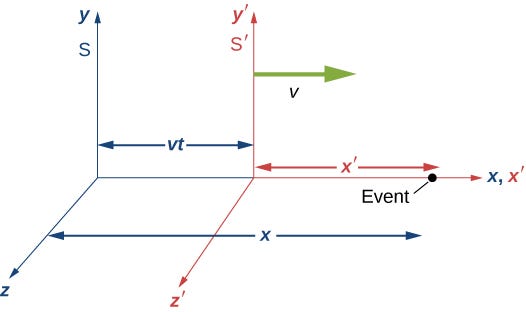
The Lorentz transformation gives this relation mathematical form. For frames moving uniformly relative to one another, it replaces the Galilean transformation used at low velocities. Its factor, γ, becomes appreciable only as relative speed approaches c; in ordinary motion, the transformation reduces closely enough to Newtonian expectations that the deeper geometry remains hidden.
Time dilation and length contraction are not optical distortions layered over an otherwise absolute world. They are properties of how events are ordered in Minkowski spacetime. The traveling twin ages less not because motion mysteriously slows a private clock, but because the twins follow different paths through spacetime and accumulate different proper times. Their reunion permits those paths to be compared.
Lorentz invariance means that the laws of physics are unchanged under Lorentz transformations. In quantum field theory, it constrains the form of fields, interactions, and conserved quantities. It does not explain, in a further metaphysical sense, why nature possesses this symmetry. Physics is often strongest at specifying the consequences of a structure before it can say whether asking for a deeper “why” is meaningful.
General relativity changes the setting without abandoning the local principle. Curved spacetime is not globally Lorentz invariant in the way flat Minkowski spacetime is, but within a sufficiently small freely falling laboratory the laws reduce to those of special relativity. General covariance, meanwhile, expresses the freedom to describe the same physics in different coordinates; it should not be conflated with a physical Lorentz transformation.
Physicists continue to test whether Lorentz symmetry is exact or an extraordinarily accurate low-energy limit. The Standard-Model Extension provides a systematic language for possible violations, and experiments across photon, matter, neutrino, and gravitational sectors have placed stringent bounds on its coefficients. The continuing data tables for Lorentz and CPT violation are best read as a record of null tests and constraints, not as evidence that a violation has been observed.
The lasting intellectual move of relativity was therefore one of restraint. Space and time ceased to be an invisible stage against which events unfolded. What remained invariant was not either coordinate alone, but the relation between them. The symmetry does not make every observer’s account identical. It specifies exactly how their differences must cohere.