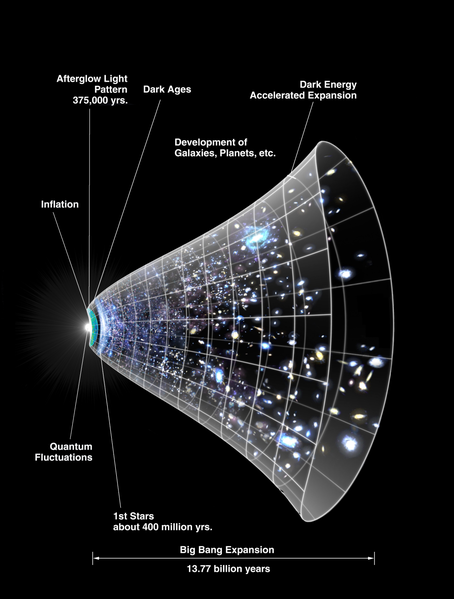
The universe does not expand by sending galaxies through space from a central point. On sufficiently large scales, the distances encoded by the geometry of space increase. Nearby gravitationally bound systems resist that expansion; sufficiently distant galaxies recede with the Hubble flow, and some light emitted today will never reach us. The effect is austere rather than theatrical: the observable universe acquires a horizon not because light becomes slow, but because the space it must cross evolves.
Within that expansion lies one of modern cosmology’s most persistent disagreements. The Hubble constant, H₀, describes the present expansion rate. Measurements tied to the early universe, interpreted through the standard ΛCDM model, favor a value near 67 kilometers per second per megaparsec. Local distance-ladder measurements, built from geometric calibrators, Cepheid variables, and Type Ia supernovae, favor a value near 73. The difference is small enough to sound technical and large enough to resist years of improved observation.
The disagreement is frequently described as two instruments measuring the same moving object. That analogy misses the dependence on inference. The early-universe value is not read directly from the cosmic microwave background. It is obtained by fitting a cosmological model to the CMB’s pattern of anisotropies and evolving that model forward. The local value climbs a ladder of calibrated distances and recession velocities. Each method contains distinct assumptions and possible systematics.
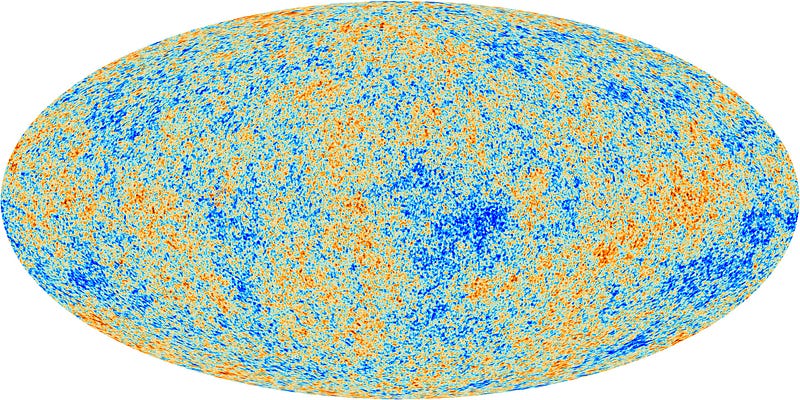
The direction of the tension is important: the local distance ladder gives the higher expansion rate. In the final Planck cosmological analysis, ΛCDM fits to the CMB yielded H₀ near 67.4 km s⁻¹ Mpc⁻¹. The SH0ES distance-ladder analysis reported a value near 73.0. Other methods often fall between them or carry larger uncertainties, which is why “early versus late” is a useful shorthand but not a complete taxonomy.
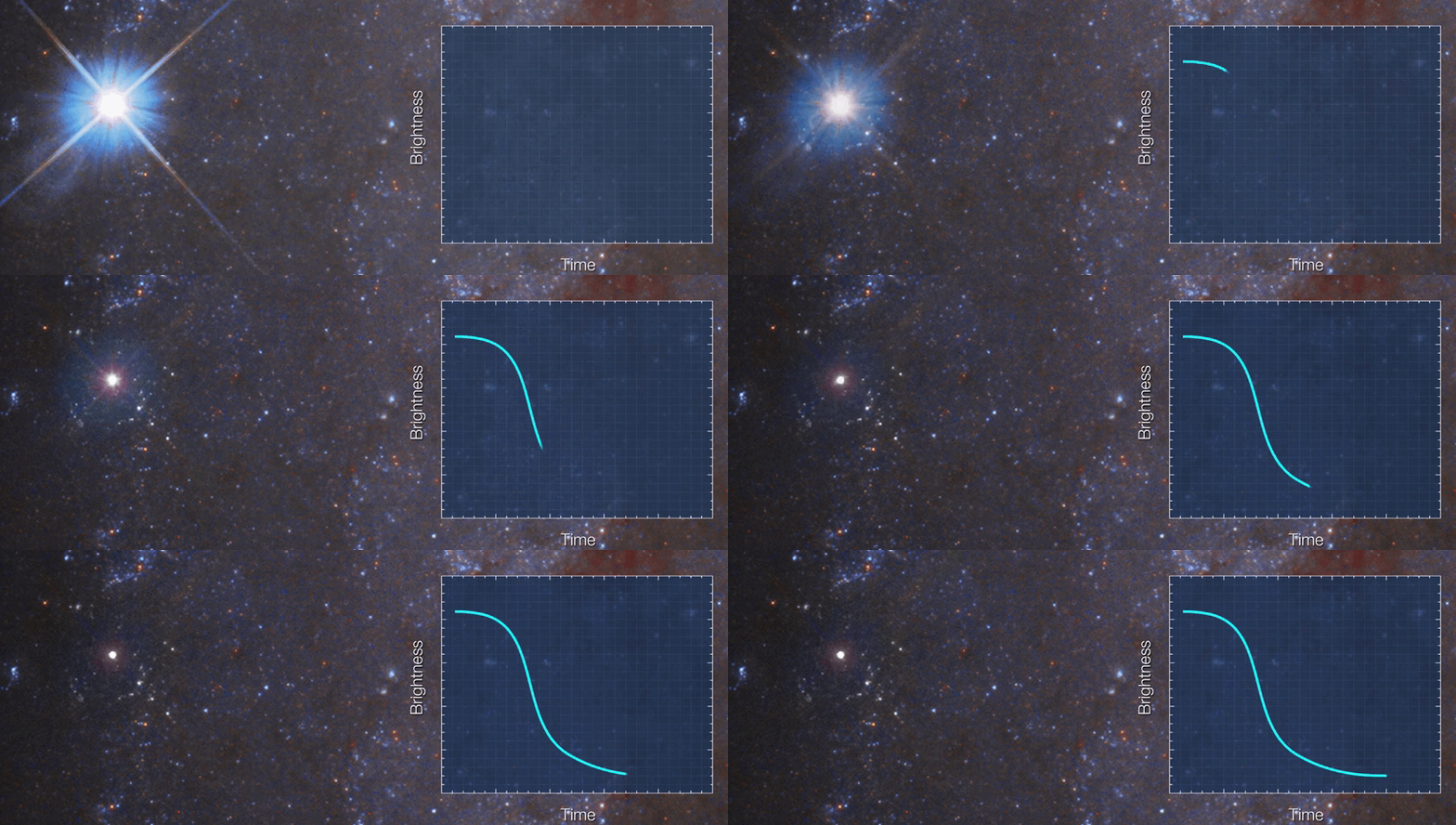
Type Ia supernovae do not determine H₀ by themselves. Their standardized luminosities map relative distances across redshift; an absolute calibration is required to set the scale. This dependence is a source of both power and vulnerability. Cepheid metallicity, photometric calibration, dust, supernova populations, and the geometry of distance anchors must all be controlled. On the CMB side, an unrecognized feature of early-universe physics could alter the inferred sound horizon and therefore the derived value of H₀.
This is why proposed solutions divide roughly into two classes. One searches for residual systematic error: a calibration, selection effect, or model dependence not yet fully represented. The other changes the cosmology, often before recombination, so that the sound horizon inferred from the CMB becomes smaller. Sterile neutrinos, early dark energy, altered recombination, and modified gravity have all been investigated. None has yet provided a solution that is both compelling and undisturbed by other data.
Dark energy belongs to the surrounding mystery but should not be used as a synonym for every tension. Cosmic acceleration is supported by multiple probes. The simplest model treats dark energy as a cosmological constant, with an energy density that remains constant as space expands. A time-varying component is possible, but the Pantheon+ supernova sample did not, by itself, establish that dark energy “activated” at a particular era or that it resolves the Hubble tension. The earlier version of this essay overstated that inference.
The temptation is to call the discrepancy a crisis, as though a revolution were already visible behind it. A more disciplined description is also more interesting. Two mature chains of inference, each sharpened by years of criticism, arrive at values that do not comfortably overlap. The resolution may be mundane, radical, or distributed across several small effects. Until it is known, the tension marks the exact point at which precision becomes epistemology: where better measurement forces us to ask what, within a number, has actually been observed.